

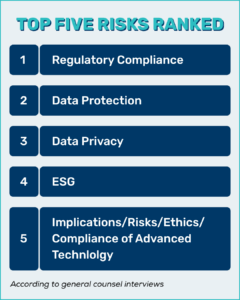
In today’s complex and ever-evolving legal technology landscape, a wide spectrum of risks are emerging, ranging from regulatory compliance to the ethical implications of new technologies. The 2024 General Counsel Report listed the top five risks affecting legal departments.
These risk areas aren’t just buzzwords, as they represent real, operational challenges that demand proactive, thoughtful leadership and deeply integrated compliance strategies by security teams. From managing compliance in a shifting legal environment to preserving trust through data privacy, this is a call to action for organizations to approach risk with clarity, accountability, and purpose.
Regulatory Compliance
There are many considerations that must be factored into a successful security and compliance program. First and foremost is regulatory compliance. The laws and regulations that apply must be adhered to. There can be no wiggle room. Compliance is mandatory.
However, the laws and requirements are constantly evolving, and this requires a dynamic team that understands risk in the changing landscape and enacts thoughtful alterations to their processes in order to provide clients with the expected level of service and protection.
The compliance team must also be completely independent and free from conflicts of interest. They cannot conduct internal audits and then be subject to the folks they audited for their performance reviews, pay raises, or bonuses. In addition, the compliance team must have an independent and direct line for reporting to the CEO/Board, and the communication must be open and candid.
Data Protection
Communication is a key consideration in data protection. Often, data protection is thought of in terms of technical controls, policies, and processes, and while those are extremely important, there is also a human side to it that is just as important and must be recognized. The compliance team cannot be everywhere at all times, so communication across teams is vital.
As part of the communication environment, employees must feel encouraged to ask questions, raise concerns, question policies, and even admit to an honest mistake. Everyone is human, and if a mistake occurs, the compliance team needs to know about it as soon as possible.
Communication requires the compliance officer to truly listen when an employee disagrees with a policy or technical control and wants to discuss it. It takes courage to voice a concern, and often the concern is shared by many employees.
Sometimes, there is a misunderstanding as to the requirement for the policy or control, and at other times, the policy or control may be out of date and need to change. It is important to remember in these discussions that all participants are trying to make the process better; they are just coming at it from different points of view that must be considered and addressed.
Data Privacy
Data privacy is also related to data protection. It, however, requires an additional understanding that we are not just dealing with data, but with individuals who are part of a shared humanity that must be respected and have an inherent right to privacy. Proper handling of this data requires a commitment to unwavering principles and ethics to ensure we do not violate the trust of the individuals this data represents.
It is also important to remember that no business operates in a vacuum. It exists within a very real neighborhood and is part of an ecosystem in which we are all mutually dependent upon each other. Businesses that interact with and assist their communities help to create lasting benefits for the business, the community, and their employees. When each works together, all benefit. Being responsible stewards of information entrusted to us can be a first step toward a safe, trusting environment that benefits the whole.
Conclusion
Just as with laws and standards, technology also changes, and there is often a strong push to be first to market with the latest and greatest deliverable. However, it is important to pause for a second to consider what this technology means in terms of regulatory compliance, data privacy, and protection, along with the company’s relationship with the community and ecosystem.
Is this technology a solution in search of a problem, or does it provide a clear and sustainable benefit? What are the risks, and can the technology be misused? Does it promote and respect the humanity of all? Each of these concerns, as well as a myriad of other questions, must be thought through in order to provide the services and protections required by our clients.
These considerations are a small fraction of the issues that must be addressed. They require an experienced team that understands the industry, knows the risks, and is committed to security and compliance. What Herodotus said nearly 2,500 years ago still rings true today: “Excellence is never an accident. It is always the result of high intention, sincere effort and intelligent execution; it represents the wise choice of many alternatives – choice, not chance, determines your destiny.”

Anthony Klier
Author
Share article:
Anthony Klier is Vice President, Security & Compliance. Mr. Klier is highly skilled in database development and systems integration. Throughout his 29-year tenure at TCDI, he has lead technical teams of developers, DBA’s and discovery engineers to plan, develop and implement solutions to complex technical challenges. He has served as project management for large-scale technical e-Discovery and case management projects of Fortune 500 and Global 500 companies. In addition, he has directly managed TCDI’s Development, Quality Assurance, Research and Client Data Services departments. Learn more about Anthony.