
TCDI Talks | Episode 17
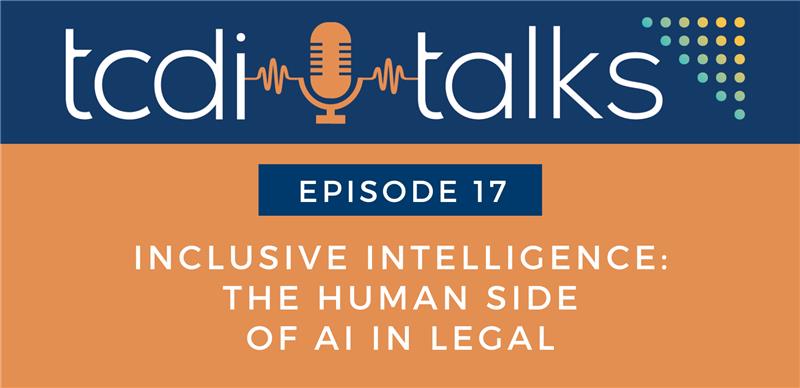
Home / Webinars / TCDI Talks / Inclusive Intelligence: The Human Side of AI in Legal | TCDI Talks: Episode 17
Inclusive Intelligence: The Human Side of AI in Legal
About TCDI Talks: Episode 17
How can artificial intelligence enhance legal workflows without losing the human insight that makes good decisions possible? Join Michael Gibeault and Emily Fedeles Czebiniak, TCDI’s Senior Vice President of Emerging Technologies, as they explore what “inclusive intelligence” really means and why diversity and ethics are key to building responsible AI.
In this 8-minute episode, Emily shares how TCDI embeds transparency, fairness, and human oversight into every stage of AI development. She explains why governance is a culture, not a checklist, and how collaboration across teams leads to smarter, more ethical innovation. Because, in the end, the future of AI in legal depends on people.
Episode 17 Transcript
0:05 – Michael Gibeault
Welcome to TCDI Talks, where we spotlight the people and ideas driving innovation in legal services and technology. I’m Michael Gibeault, your host, and today we’re exploring how artificial intelligence can be integrated into legal workflows responsibly and ethically.
Joining us is my colleague, Emily Fedeles Czebiniak, TCDI’s Senior Vice President of Emerging Technologies, to discuss her article, “Inclusive Intelligence: The Human Side of AI in Legal.”
Welcome, Emily.
0:38 – Emily Fedeles Czebiniak
Thank you. It’s great to be here.
0:41 – Michael Gibeault
Well, Emily, at TCDI, we believe technology achieves its full potential when it’s shaped and guided by people with diverse perspectives and expertise, and this philosophy is what we call “inclusive intelligence.”
So, Emily, let’s start there. Can you explain what inclusive intelligence means?
1:01 – Emily Fedeles Czebiniak
Certainly. Inclusive intelligence is the idea that technology performs best when it’s guided by diverse human insight. So, it’s about pairing human oversight, ethics, and creativity with the speed and scale of AI.
So, at TCDI, we think of that as a partnership. Like where data scientists, attorneys, technologists, and client teams all contribute their expertise to how AI is designed, deployed, and governed. The more inclusive minds around the table, the smarter and more ethical the technology becomes.
1:32 – Michael Gibeault
So, Emily, in your article, you write that AI is only part of the process. So, how do you see the relationship between the human judgment and AI evolving in eDiscovery?
1:47 – Emily Fedeles Czebiniak
So, this is an interesting, evolving relationship. AI is certainly transforming eDiscovery, but it doesn’t replace human judgment. It just refines it. As models get better at identifying relevance or patterns, for example, human reviewers focus more of their time on being strategic decision makers.
So, we’re moving towards spending more time in workflows where AI handles the volume and pattern recognition, and humans provide the context, the ethics, and the reasoning. So, the future isn’t AI instead of people, it’s AI with people. People who are empowered to question, interpret, and guide its output.
2:22 – Michael Gibeault
So, Emily, from your perspective, what makes eDiscovery uniquely suited, or uniquely challenged, when it comes to adopting AI responsibly?
2:32 – Emily Fedeles Czebiniak
eDiscovery sits at the intersection of data, law, and human behavior, which makes it both an ideal and a high-stakes testing ground for AI. We deal with sensitive, complex information where context matters enormously.
So, a model that performs well in another industry or sector might completely misread legal nuance or privilege. That’s why governance, transparency, and human oversight are so essential here.
2:57 – Michael Gibeault
So, many organizations talk about inclusion, but fewer make it a true part of their innovation strategy. Why is inclusion so important and not just a value on paper?
3:11 – Emily Fedeles Czebiniak
Absolutely. Inclusion isn’t just a value, it’s a competitive advantage. Because inclusion is innovation. Diverse teams ask different questions, they catch different blind spots, and they push ideas further.
At TCDI, we’ve seen how mixing legal, technical, and client perspectives leads to smarter solutions, whether it’s improving review workflows or refining a model. Inclusion moves from being a feel-good value to a performance driver.
3:37 – Michael Gibeault
In your article, you cite research showing that diverse teams outperform others in creativity and innovation. Why do you think diversity has such a measurable impact on how teams approach technology?
3:51 – Emily Fedeles Czebiniak
When teams share similar backgrounds, they often share similar assumptions, and those assumptions can be the root of bias. Diversity helps break that echo chamber and forces you to validate your data, your design, and even your decision logic. That’s how innovation happens. By challenging what “normal” looks like.
Diversity doesn’t just change who’s in the room. It changes what’s possible in the room.
4:15 – Michael Gibeault
Well, you make the point that AI is only as fair as the people who build and train it. What practical steps can teams take to identify and reduce bias in their AI systems?
4:29 – Emily Fedeles Czebiniak
So, first start with the data. You audit it for representations and for fairness, and then you test your models continuously with diverse review groups to catch bias before deployment.
So, here at TCDI, we use cross-functional working groups that include legal, technical, and client voices. They review not only the outputs but also the assumptions baked into the system. Bias mitigation isn’t a one-time project. It’s a continuous process of testing and learning.
4:54 – Michael Gibeault
So, governance often sounds procedural, but you describe in your article it has something cultural about it. How does TCDI make responsible AI governance part of everyday decision-making?
5:09 – Emily Fedeles Czebiniak
Yeah, absolutely. Here it’s not just like a policy, it’s part of how we think. We treat governance as culture, not as just compliance. It’s built into how we make choices every day, from data handling to model validation to client communication.
Our teams are trained to ask, “should we?” as often as they ask, “can we?” This mindset ensures AI development stays transparent, ethical, and human centered.
5:33 – Michael Gibeault
So, when we think about bias in AI, where do you see the biggest risks? Is it data, design, or decision-making?
5:43 – Emily Fedeles Czebiniak
All three are certainly connected, but I think decision-making is where the rubber meets the road. Even a fair data set and a sound design can be undermined if humans interpret results without context.
Data and design set the stage, but decision-making determines whether bias actually impacts outcomes. That’s why human oversight — inclusive, multi-disciplinary oversight — is essential.
6:07 – Michael Gibeault
So, how do you communicate complex ideas like fairness or transparency to clients who may just be starting to explore AI tools?
6:17 – Emily Fedeles Czebiniak
We focus on clarity and collaboration. Instead of talking in abstract technical terms, we show how the model works and where humans remain involved. Clients seem to appreciate when we explain the safeguards: the bias testing, the audit trails, the human-in-the-loop review. Transparency builds trust, and trust is what allows responsible innovation to thrive.
6:40 – Michael Gibeault
So, you talk about AI in your article as a way to enhance human judgment. What do you think the ideal human-AI partnership looks like in a legal workflow?
6:53 – Emily Fedeles Czebiniak
Ideally it’s symbiotic. AI handles the volume, the pattern recognition, and the speed. Humans provide the judgment, the ethics, and the strategy. The best workflows are those where AI enhances the human capabilities, freeing the professionals to focus on parts of the job that require the empathy, the reasoning, and the creativity — the human side of things.
7:14 – Michael Gibeault
As AI becomes a regular part of eDiscovery, what skills or mindsets do you think will become essential for professionals in this field?
7:26 – Emily Fedeles Czebiniak
I think most important are curiosity and adaptability. The most valuable professionals will be those who understand both the technology and its human implications. So, certainly technical literacy will matter, but so will ethical literacy — knowing when to question the output and how to guide the system responsibly.
7:43 – Michael Gibeault
So, let’s look beyond the legal industry. Are there lessons from other sectors that inspire how you and your team approach responsible AI development?
7:55 – Emily Fedeles Czebiniak
Yes, certainly. I think healthcare is a great example. That sector shows how human oversight and ethics can coexist with automation. A doctor doesn’t let an algorithm diagnose a patient on its own. The doctor interprets the AI output via her training and human experience. That can help serve as an inspiration for the model that we should emulate in legal; AI as AN assistant, not as THE authority.
8:19 – Michael Gibeault
Well, Emily, thanks for joining us today on TCDI Talks. For our viewers, if you’d like to learn more about how inclusion strengthens innovation and ensures AI is developed with fairness and transparency, check out Emily’s article linked next to the video.
Thanks for joining us.
8:36 – Emily Fedeles Czebiniak
Thank you so much.
Meet the Experts Behind the Topic
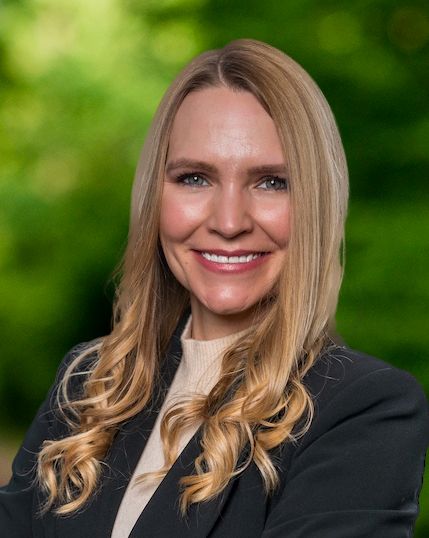
Emily Fedeles Czebiniak | SVP, Emerging Technologies | TCDI
Emily brings over 14 years of experience as a practicing lawyer with a career spanning litigation, eDiscovery, privacy, cybersecurity, and artificial intelligence (AI). Most recently, she has focused on advising on AI governance and the use of GenAI and large language models (LLMs). She is known for bridging the gap between people and technology to deliver innovative, practical solutions to complex client challenges.
At TCDI, Emily plays a pivotal role in advancing our technology strategy, particularly in integrating AI into workflows and innovative solutions. As recognized thought leader in the fields of technology, data, and privacy, Emily frequently shares her expertise through speaking engagements and published scholarship, making her a trusted strategic partner to clients and colleagues alike.
Meet Our Host

Michael Gibeault | Senior Vice President, Legal Services | TCDI
As Senior VP, Legal Services, Michael Gibeault works closely with corporate legal and law firm clients alike, providing forensics, eDiscovery, and managed document review solutions while managing a team of Legal Services Directors.
Michael’s tenured career has focused on supporting law firms and corporate legal departments with creative and cost-effective solutions that rely on cutting-edge technology and highly skilled legal professionals. Prior to joining TCDI in 2017, he served in executive positions at DTI Global, Epiq, Robert Half International, LexisNexis, and Martindale Hubbell.

Only Have a Minute? Check Out the Highlights!
In Case You Missed It